Dujiangyan Irrigation System Travel Guide
Unveiling the Ingeniuty of China’s Oldest Water Management System
Located about 60 km from Chengdu, Dujiangyan is home to one of China’soldest and most unique irrigation systems in China. Often mistakenly referred to as the Dujiangyan Dam, it is, in fact, theonly surviving non-dam irrigation system from the ancient world.
Dating back over 2,200 years, the Dujiangyan Irrigation System was designed to prevent flooding and ensure a steady water supply to the fertile Chengdu Plain. Today, it forms the centerpiece of theDujiangyan Scenic Area, a sprawling 220-hectare site with over 20 unique attractions for visitors to explore.
Within the scenic area, you’ll encounter not just this marvel of ancient Chinese engineering but also historical landmarks such asErwang Temple,Yuwang Temple, theAnlan Suspension Bridge, and theAncient Songmao Path. The natural beauty of the site, with theMing RiverandYulei Mountainas its backdrop, adds to the serene atmosphere of this historic location. For panoramic views, theYulei Pavilionatop the mountain offers breathtaking views of Dujiangyan city and the irrigation system project below.
This groundbreaking project was the brainchild of Li Bing, a local official of Sichuan Province, and was constructed with the labor of tens of thousands of workers. The system relied on innovative methods, including long bamboo baskets filled with stones (Zhulong) and wooden tripods (Macha), to manage water flow, reduce flooding, and drain sediment, all while utilizing the region’s natural topography and hydrology.
Recognized as a UNESCO World Heritage Site, the Dujiangyan Irrigation System stands as a formidable example of the ancient ingenuity and skills, continuing to support the agricultural prosperity of the Chengdu Plain to this day.
What to see in Dujiangyan Irrigation System
1. Nanqiao (Dujiangyan South Bridge)


Before entering the Irrigation System Complex, consider visiting the Dujiangyan South Bridge, orNanqiao. Situated to the left of the Dujiangyan Irrigation System entrance, this impressive bridge spans theNeijiang River, linking South Street to Fuxing Street.
Nanqiaois an ancient corridor-style bridge with a unique style. Historically, covered bridges like Nanqiao served as gathering places for locals to gather, engage in trade, entertainment, and even worship the gods.
Today,Nanqiaostands out not only as a historical landmark but also due to its unique architectural style and cultural atmosphere. The bridge's galleries work as an open-air museum featuring intricate wood carvings, traditional paintings, and calligraphy. Under the nocturnal illuminations, theSouth Bridgetransforms into a mesmerizing spectacle, creating a vibrant night scene.
2. Qinxi Garden


Upon entering the Dujiangyan Irrigation System, visitors are welcomed by the lush Qinxi Garden. Adorned with vibrant flowers and captivating water features, the garden offers a serene environment anchored by the presence of theImmortal Tortoise Poundat its center.
Within this picturesque landscape lies theFulong Temple(Dragon-Taming Temple) first built in the Jin Dynasty in memory of Fan Changsheng – the leader of Tianshi Taoism. Legend says thatFulong Templeis where Li Bing defeated the evil dragon during the construction of the irrigation project.
It now houses astone statue of Li Bingin the front hall, excavated from the river in 1974. TheFulong Temple Lookout Pavilionprovides one of the best panoramic views of the Dujiangyan Irrigation System scenery.
3. Alan Cable Bridge


Crossing both theOuter Riverand theInner River, theAnlan Suspension Bridgeholds a reputation as one of the Top Five Bridges from ancient China. Serving as the classic representation of Dujiangyan's landscape, this 261-meter bridge was originally constructed before the Song Dynasty (960 ~ 1279) using a combination of rope and wood.
Despite facing the test of time and being rebuilt numerous times,Anlan Suspension Bridgestands today as a testament to the region's enduring heritage, with the most recent reconstruction completed in 1974.
4. Qinyan Tower
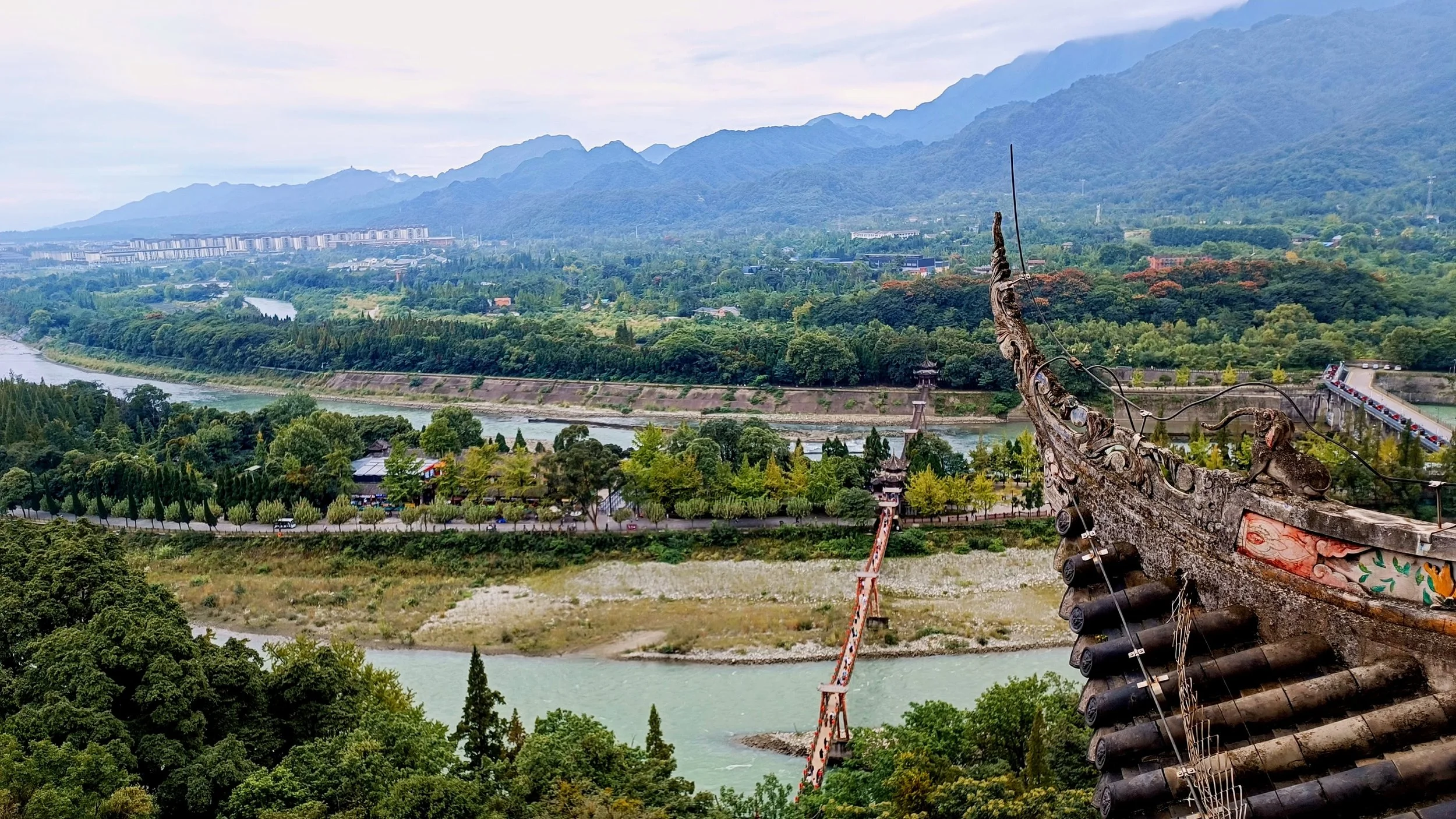
Follow along the path up the mountain to find the seven-storeQinyan Tower. The tower does not have much inside, besides a couple of small stores selling food and drinks. However, this is the best site for amarvellous at the full scene of the Dujiangyan Irrigation Systemand it’s main features, namely:
Yuzui:A water-dividing dike, designed to divide the Ming River into two parts. The western part (Outer River) drains off the floodwaters while the Inner River is used for irrigation.
Feishyan:A flood discharge mechanism which is the key to protecting Chengdu Plain from flood. It works as flood discharge, regulating water level by overflowing when theBaopingkouupper limit is exceeded.
Baopingkou:A diversion project, which works as a control valve. It can control the water flow of the Inner River automatically. The natural scenery ofBaopingkouis stunning, and it was a famous attraction already in ancient times.
5. Erwang Temple


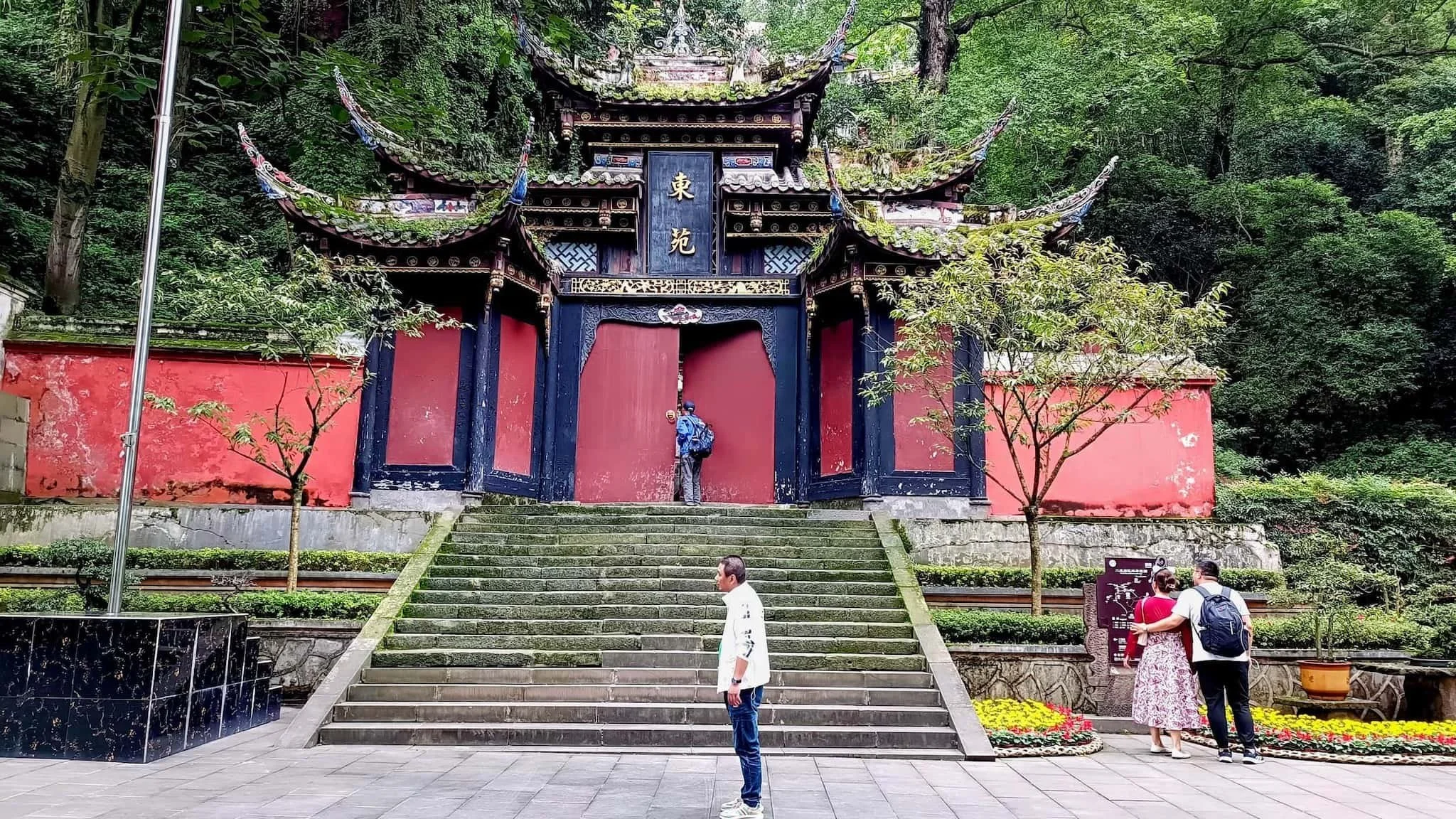
Located on the right bank of the Minjiang River, across theAlan Suspension Bridge, lie theEastern Gardensand the magnificentErwang Temple(Two Kings Temple). TheErwang Templepreserves the architectural essence of the Qing Dynasty (1644-1911), adorned with Chinese characters narrating the tales of water management engraved on its stone walls.
Initially built as atribute to the Shu King, the temple's purpose shifted later tohonour Li Bing and his sonduring the Jianwu Period (494-498). Li Bing and his son were awarded as kings in succession by Song emperors, hence the name Two Kings Temple.
The rear hall, theLi Bing Memorial Hall, enshrines a modern statue of Li Bing and his son and features a courtyard that faces an opera stage. On Li Bing's traditional birthday, on the 24th day of the 7th month of the lunar calendar, local operas were performed for the public, and on Tomb Sweeping Day aWater Throwing Festivalis held in this location.
6. Ancient Song Mao Road

Exit Erwang Temple to the left to find the Ancient Song Mao Road past the West Pass.
A well-preserved section of the Ancient City Wall as well the Rhinoceros fighting platform can be found here and are yet another great viewpoint of the irrigation system.
The Ancient Song Mao Road is a historical artery that connects the Chengdu Plain and the northwest plateau of Sichuan. Follow this ancient path to get to the Guanxian Ancient Town.
7. Town God Temple


On the way to the Ancient Town Centre, you’ll encounter theTown God Temple. This historical gem, dating back to theMing Dynasty, sprawls across an impressive3,000 square meters. The temple can be divided into two distinct areas:
The upper section is dominated by theChenghuang Hall, a magnificent structure that pays homage to the local deity.
On the lower area lie theTen Temples, each dedicated to one of theten kingsenshrined within. These temples stand in symmetrical alignment in a picturesque ascending staircase road connecting the ancient town ofGuanxianto the majesticYulei mountain.
Where to eat in Dujiangyan


Within the Dujiangyan Irrigation System Complex, there is adiversity of food stalls and coffee shopsto choose from, especially on the riverside on theleft river bank. They serve mostly Chinese snacks and are a convenient choice for a quick lunch but admittedly not the best quality. On theright river bank, there are not many options to buy food from but there is an enjoyable picnic spot, which you can use in case you have bought your own food.
If you are interested intasty traditional food, your best bet is to explore the centre ofGuanxian ancient town.The centre ofGuanxian Ancient Towncan be reached through theAncient Song Mao Roador right past theNanqiao Bridge.Guanxianoffers a myriad of restaurants, stores and food stalls serving mouth-watering traditional Sichuan dishes and all kinds of snacks and drinks.
Where to stay in Dujiangyan


The most common base to explore the Dujiangyan Irrigation System isChengdu. Chengdu is a major metropolis and the capital city of the Sichuan Province. Given it’s size it has a wide range of accommodation options for all wallets. Additionally, it is very well connected to all major cities in China through speed trains and offers a huge variety of gastronomic and entertainment options.
Alternatively, if you prefer to stay in a calm idyllic location near the mountains we recommend staying at theQingcheng Shan village. Staying at Qingsheng Shan allows you to enjoy this incredible location for longer without the worries of catching the next train and to calmly visit all the stunning nearby attractions such as theQingsheng Shan Front Mountainand theBack Mountainon a multi-day trip.
The village offers many delicious traditional restaurants with super fresh locally grown foods that guarantee a great culinary experience when visiting Qingsheng Shan. Moreover, there are high-quality hotels for every budget, many of them offering relaxing thermal pools for you to recover after a long day see-sighting day. Some suggestions for hotels in the Qingcheng Shan area are highlighted below and can be easily booked in advance through our partnerTrip.com.
How long to visit Dujiangyan
It is possible to visit the Dujiangyan Irrigation System on ahalf day tripkeeping a slow pace. However, if you like to visit the other attractions in Dujiangyan such as theSouth Bridge, theTown God Templeand the cute little stores and restaurants in theGuanxian ancient townit is best to reserve an entire day to fully absorb this location. A day will give you time to, not just to see all the main sights, but also to buy souvenirs and taste the local delicacies.
For a more fast-paced alternative consider combining the Dujiangyan Irrigation System withQingsheng Shan Mountainarea:
At theFront Mountainyou can immerse yourself in the spirit of Toaism within the setting of the Dream Works famousKung Fu Panda.
If you prefer to go for a hike, theBack Mountainoffers the opportunity to discover the lush natural habitat of the pandas.
Regardless of the experience you choose, if you decide for this fast-paced option it is recommended to book an organized tour to save time on transportation. Here are a couple of alternatives to consider:
How to get to Dujiangyan
From Chengdu
The best way to get to Dujiangyan is to get aspeed train from Xipu Station in Chengdu. It will take you to Dujiangyan in approximately20 minutesand costs10 RMB. This proximity makes Chengdu a convenient base to explore the Dujiangyan Irrigation System.
Once at Dujiangyan train station, you can either get one of the available taxis nearby or convenientlybook a taxi with the Didi app, which can be found onWeChat. It takes about25 minutesby car to reach the Irrigation System from the train station.
From Qingcheng
Thespeed trainalso connectsDujiangyan to Qingchengshan. The journey takesless than 10 minutesandcosts 5 RMB.
However, taking into consideration the distance from the train station to the Irrigation System it is more effective to go directly throughtaxi or Didi as Qingcheng Shanis locatedless than 30 minutes away by car.
Alternatively, if you would like to get a worry-free journey you can always book one of the many organized tours offered by our partners:
Best time to visit in Dujiangyan
Spring (March to May):During spring, the mountain and gardens come alive with vibrant colours as flowers bloom, creating a picturesque landscape. The weather is generally mild, making it comfortable for exploring on foot the scenic area.
Summer (June to August):The summer months can be hot and humid, which may make your trip less comfortable. However, this region offers the mildest Summer temperatures in the Sichuan province which makes it quite popular during the summer vacation period, leading to larger crowds and longer wait times.
Autumn (September to November):Similar to spring, autumn offers mild temperatures, making it suitable for outdoor activities. The fall foliage paints the mountain in hues of red, orange, and yellow, creating a stunning visual spectacle. Compared to the peak summer months, autumn tends to be less crowded, allowing for a more tranquil experience.
Winter (December to February):Winter brings colder temperatures, and some areas of the region may experience snowfall. If you don't mind the cold, winter can be a quieter time to visit with fewer tourists.
Current Weather in Dujiangyan

Is it worth visiting Dujiangyan
If you areinterested in Chinese engineering and ancient culture, theDujiangyan Irrigation Systemis definitely worth visiting. As the only surviving non-dam irrigation system from the ancient past, theDujiangyan Irrigation Systemis a unique sight that has shaped the present Sichuan region by controlling the flooding on the Min River and irrigating this previously arid area.
The fantastic setting of the Dujiangyan Irrigation System makes this an appealing site also fornature lovers, religion and architecture enthusiasts. Located atop the Min River and at the foot of the Yulei mountains the Dujiangyan Irrigation System has a relaxing atmosphere that invites visitors to walks and exploration of this inspiring landscape. The magnificent Taoist Temples and ancient buildings of Guanxian add to the charm of this distinctive site.
If you’re planning to spend a few days exploring Chengdu and its surrounding areas, consider combining a visit toMount Qingchengwith the Dujiangyan Irrigation System for an unforgettable experience.
Nearby attractions


Travelook App
For additional itineraries on China and beyond download the Travelook app!
Use Travelook functionalities to prepare your next trip:
- Get AI generated recommendations
- Use Maps to discover places to visit, restaurants, cafes, things to do and much more!
- Book flights, tours and attractions tickets in one place
- Invite your friends to collaborate on your travel plan
- Follow other travel entusiasts for ideias and tips


Don’t forget to follows us!
Disclosure:Some of the links in this post may be affiliate links. This means that if you click on the link and make a purchase, we may receive a small commission at no extra cost to you. This helps us continue to provide valuable content and recommendations for our readers. Thank you for your support!